
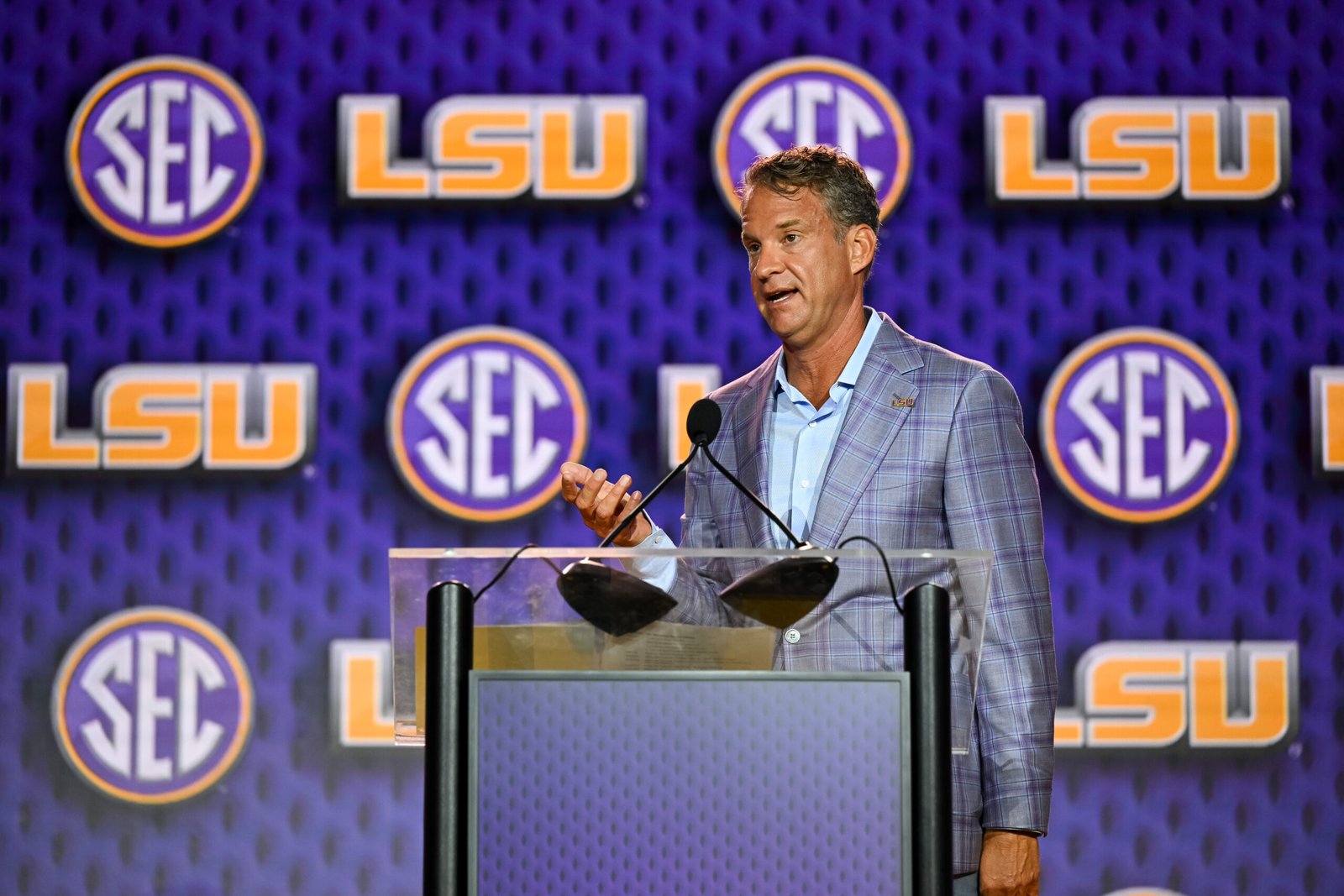
The Southeastern Conference isn’t just annoyed with LSU right now. It’s talking about serious punishment.
According to a Yahoo Sports report from Ross Dellenger, SEC general counsels and university presidents have spent the last day or two trading ideas on how to punish the Tigers for signing athletes who already inked pro contracts.
Those talks aren’t coming from the league office.
They’re coming straight from the schools themselves. Fifteen of the 16 SEC members are involved.
LSU isn’t part of the conversation, for obvious reasons.
Nobody’s made a final call yet.
That’s not surprising since a judge in Baton Rouge is set to hear arguments Thursday in the case that started this whole mess.
Tension boils over among league schools
But the mood among other schools is anything but patient.
“Tensions are high,” one university executive told Yahoo Sports.
Another put it even more bluntly when talk turned to kicking the Tigers out of the conference entirely.
“It is fair to say we are discussing multiple options, including that,” the person said. “Enough is enough. This is ridiculous.”
Nobody’s found the word “expulsion” anywhere in the SEC’s actual bylaws.
What is written in there, tucked into Section 4.1.2, hands conference presidents and chancellors a wide range of options instead: they can bench a school from championship or league play, place it on probation or reach for some other penalty they decide fits the crime.
In other words, do just about anything a majority of the membership agrees it wants to do.
Legal hurdles complicate any punishment
There’s a simpler route too. Some schools are reportedly considering just refusing to take the field against LSU if the Tigers roster a player the SEC considers ineligible.
“We can’t make anyone play them,” one person familiar with the discussions said.
Here’s a wrinkle most fans don’t think about. Fifteen of the 16 SEC schools are public universities, and that status comes with a legal shield most organizations don’t get: sovereign immunity under the 11th Amendment.
Vanderbilt is the lone private school in the group, so it’s the one member without that protection, and that’s a big reason a straightforward federal lawsuit against the Tigers isn’t as simple as it might sound.
One school staffer summed up the uncertainty everyone seems to feel.
“I’m not sure [the SEC presidents] know what they can do, but they are exploring possibilities,” the staffer said.
Another source didn’t hold back on what’s at stake for the program at the center of it all.
“The risk is enormous for LSU,” that person said.
How the LSU case escalated
A judge in Baton Rouge is the reason any of this is happening.
Late this summer, that judge ruled that a group of more than 40 athletes deserved one more season on the field, a group that includes players who’d already signed pro contracts and taken NFL practice reps.
The ruling stopped the NCAA from applying its normal eligibility and transfer rules to that group.
The fight escalated fast from there. Athletes amended their complaint Friday to pull the SEC into the same restrictions, and the judge allowed it.
One day later, the conference notified the athletes’ lawyers that it and commissioner Greg Sankey would honor the ruling for now, a decision that cleared the way for players to start signing with LSU.
Two of LSU’s new commitments came straight from a rival. Tight end Dae’Quan Wright and defensive tackle Zxavian Harris both played for Ole Miss last season.
Along with a third pro-contract signee, their moves run headfirst into two separate SEC rules, one banning pro athletes outright and another blocking players from switching league schools outside the transfer portal window.
LSU stands firm behind its coach
LSU isn’t the only program testing these boundaries.
Cole Hutson landed his own state injunction and is still taking reps at Texas.
Over at Kentucky, a deal to bring in former Missouri big man Mark Mitchell, who’d played in the NBA summer league, fell apart when Mitchell chose to re-enroll at Missouri on Monday instead.
Still, nobody’s pushed as hard or as publicly as the Tigers, with coach Lane Kiffin and Gov. Jeff Landry both defending the approach.
Kiffin told reporters Aug. 24 that the athletes suing the NCAA were “wronged” by bad timing on the new eligibility policy and said he’s simply chasing a “relentless pursuit of excellence.”
Landry offered his own take in a statement: “Don’t hate the player; hate the game.”
If you’re wondering whether LSU would just accept a punishment and move on, don’t count on it.
A courtroom fight looks inevitable
Everything about how the program has handled this points toward digging in rather than backing down.
That likely means lawyers, filings and a courtroom fight that could stretch well past this season.
The SEC isn’t hiding from that fight either.
In a Sunday statement, the league said it’s “prepared to contest the allegations in the plaintiffs’ petition at Thursday morning’s hearing and defend the SEC’s rights as a voluntary association to fulfill its mission to its member institutions.”
Timing makes this even messier.
A roster rule the SEC passed back in April closes the door on adding players once a team has kicked off its first game.
The Tigers’ opener comes two days after Thursday’s hearing, when LSU hosts Clemson in Kiffin’s debut at Tiger Stadium. Whatever the judge decides could shape the roster right up to kickoff.
This case is also part of something much bigger than one program.
A nationwide eligibility crisis
A change to the NCAA’s eligibility rules this summer moved athletes from four seasons to five, but left out players who’d already used up their old eligibility before the change took effect.
The fallout was immediate. Over 60 lawsuits and more than 300 athletes are now tied up in the fight nationwide, and some of those players had already signed pro contracts before they even found out the rule had changed.
Judges haven’t agreed on much. Nevada, Ohio and New York courts have sided with the NCAA, along with one federal case out of Colorado, while plenty of other rulings have gone the other way.
The Big Ten, Big 12, ACC and SEC each rushed out their own pro-player bans within two days of each other, hoping smaller conference rules would hold up better in court than anything the full NCAA tried to enforce.
The College Football Playoff is reportedly set to discuss a similar ban next week.
For now, LSU’s pro athlete eligibility case is the one everyone in the SEC is watching closest, and Thursday’s hearing is just the next stop on a much longer road.

